

Zenzic

Enhancements

P-CAL Case Study

P‑CAL is part of the UK Government’s CAM Pathfinder Enhancements programme. It builds on earlier 5G CAL and V‑CAL work by moving autonomous logistics into a live port environment for the first time.

Project overview

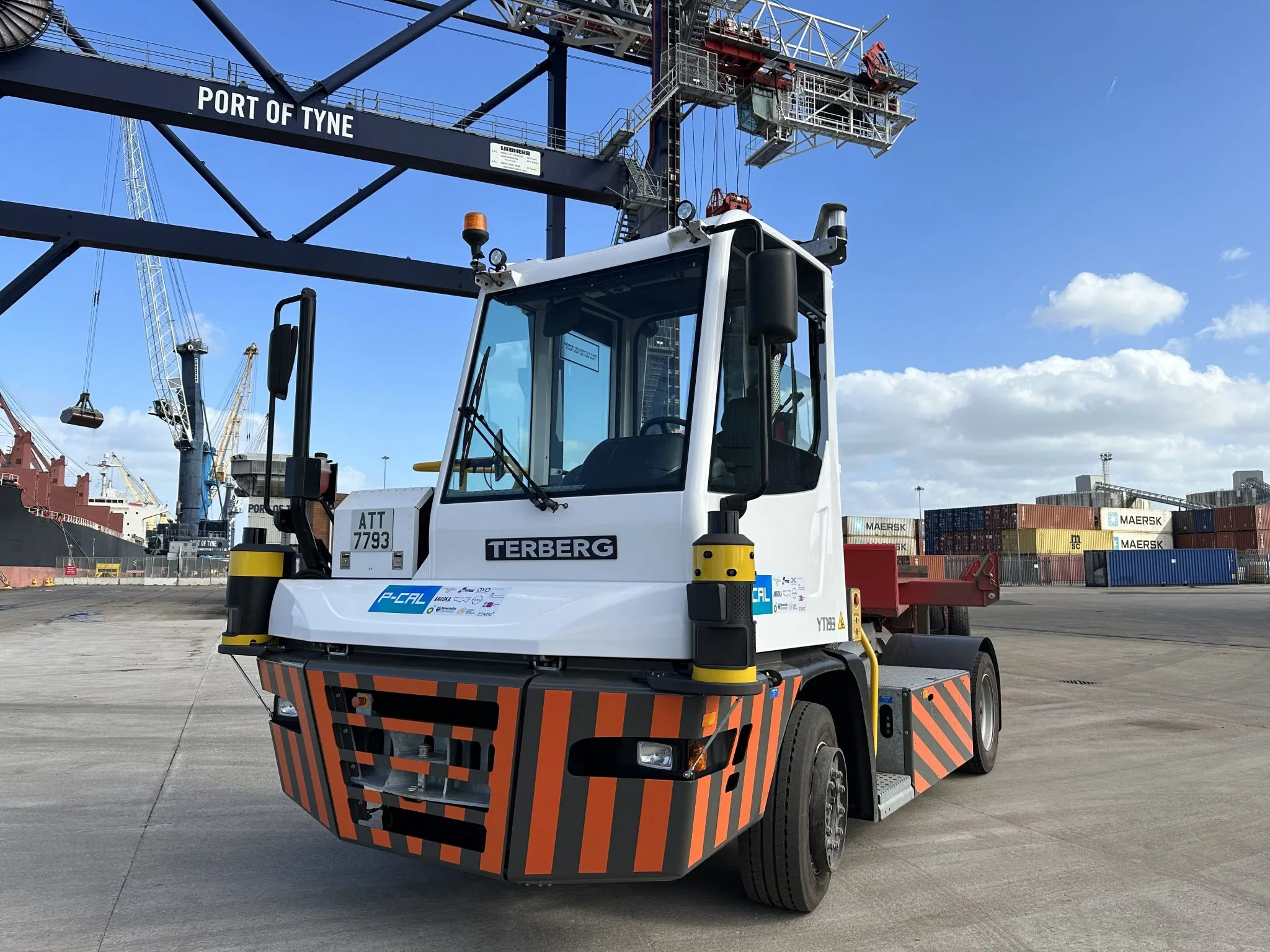
The P-CAL (Port-Connected and Automated Logistics) project has deployed an autonomous vehicle as a proof of concept to move shipping containers from the point of unloading at the Port of Tyne to an on-site storage and distribution area.

This £1.6 million project has demonstrated that an autonomous tractor (tug) can operate safely and effectively within a busy, live port environment characterised by constantly changing variables.

The success of this proof of concept is enabling the planning for a proposed scale-up project, which will see four autonomous vehicles moving containers at the Port of Tyne as part of day-to-day operations.

P-CAL is funded by UK Government, as part of the CAM Pathfinder Programme. CAM Pathfinder is delivered by DBT’s Connected and Automated Mobility (CAM) team, in partnership with Innovate UK and Zenzic.

Context and Opportunity

50% of all cargo arriving at the Port of Tyne is destined for the Nissan factory in Sunderland, while 80% of the cars built by Nissan are exported via the port. The future of the port, Nissan, and the wider supply chain is therefore closely interconnected.

Nissan’s Sunderland plant is recognised as the most productive automotive facility in Europe. This is partly due to the early adoption of autonomous guided vehicles (AGVs), first deployed in 2007. Today, Nissan operates over 550 in-house designed AGVs across the site.

Previous projects—including 5GCAL (2020) and V-CAL (2022)—enabled automated vehicle movements between Logisteed’s (formerly known as Vantec Europe) auto-parts warehouse and the Nissan factory via a private road. This has supported highly efficient just-in-time delivery operations.

P-CAL builds on this foundation, demonstrating that the same proven technology and delivery partners can be applied to automate container movements within the Port of Tyne. This represents a critical step towards automating a significant proportion of Nissan’s end-to-end logistics chain.

The UK logistics sector is facing a well-documented and growing shortage of qualified HGV and specialist vehicle drivers. This is driven by an ageing workforce, increasing demand for freight movement, and a limited pipeline of younger entrants into the profession.

Within port environments, these pressures are particularly acute, where operations require highly skilled drivers working in complex, safety-critical conditions.

P-CAL addresses this challenge by demonstrating how autonomous vehicle technology can support and sustain logistics operations, ensuring continuity of service and resilience in the face of workforce constraints.

Rather than replacing existing roles, autonomous systems provide an opportunity to:

  • Reduce dependency on hard-to-recruit specialist drivers
  • Enable workforce redeployment into higher-value, supervisory, and technical roles
  • Improve the attractiveness of careers in logistics through the introduction of advanced technologies
  • Provide the customer with more operational flexibility by allowing autonomous vehicles to handle well-defined, repeatable routes. Freeing up skilled drivers to support tasks that need human judgement or more varied activity.

The long-term vision is a fully connected, autonomous logistics ecosystem in which:

  • Containers are moved autonomously from dockside to storage
  • Containers are transported from the port to Vantec Europe’s warehouse (including via public roads)
  • Parts are delivered autonomously from warehouse to factory
  • Finished vehicles are transported autonomously back to the port for export

This would further enhance the productivity of Europe’s most efficient car plant and strengthen the long-term resilience of automotive manufacturing in North East England.

Challenges

Deploying autonomous container tugs within a live port environment presents several technical and operational challenges:

  • Dynamic crane operations:
    Containers are handled by two gantry cranes and seven mobile cranes. Autonomous tugs must continuously track crane positions and align precisely for loading and unloading, with an accuracy requirement of approximately 1.5 inches.

  • GPS signal disruption:
    The scale and structure of steel cranes can obstruct satellite signals, requiring the development of alternative geo-location solutions to maintain positioning accuracy.

  • Highly variable storage environment:
    The container compound and operational areas of the port are constantly changing due to ongoing operations by human-driven vehicles and cranes. Autonomous systems must dynamically map the environment, optimise routes, and identify correct unloading locations in real time.

Objectives

The key objectives of the P-CAL project were to:

  • Safely and successfully operate an autonomous tug within a busy, dynamic port environment
  • Prove that autonomous container movements can be coordinated with the port’s terminal operating system, supporting dynamic load and unload locations rather than fixed or pre‑defined routes
  • Maintain robust cybersecurity and network connectivity to enable telemetry and remote supervision

Generate operational insights and define a clear pathway for large-scale deployment

Key Outcomes

  • Successful conversion of a standard Terberg tug into a fully autonomous vehicle
  • Integration of Oxa’s autonomous technology using Terberg’s existing drive-by-wire system, supporting future commercial scalability
  • Demonstration of fully autonomous container loading, transport, and unloading operations
  • Demonstration of how autonomous vehicle control systems can interface with terminal operations to support dynamic load, unload, and routing decisions during live port trials.
  • Deployment by ANGOKA of a first-of-its-kind quantum-safe, secure digital infrastructure and mesh communications network, validated for telemetry and teleoperation fallback

Impact and Future Potential

P-CAL has enabled a clear pathway to scale, with a proposed follow-on trial deploying four autonomous tugs at the Port of Tyne—matching the current number of manned vehicles used for these operations.

In the North East, a future phase will extend autonomous operations onto public roads, connecting the Port of Tyne with Vantec Europe’s warehouse—representing a significant step towards fully integrated, end-to-end logistics automation.

P-CAL establishes a blueprint for a UK-designed and delivered autonomous container logistics solution with robust cyber security that can be replicated across UK ports, strengthening both productivity and the security of critical national infrastructure.

This positions the UK at the forefront of connected and automated mobility, while helping to secure the long-term competitiveness of key industries such as automotive manufacturing and logistics.

This project has demonstrated how targeted innovation can address real-world industrial challenges—supporting workforce sustainability, improving operational resilience, and unlocking productivity gains within critical national infrastructure.

Partners

Technology Partners

Oxa

Role in the project

  • Leads the development and integration of autonomous and remote-operation technologies.
  • Provides the autonomous driving software stack, virtual testing capability, and fleet management systems.
  • Responsible for autonomous vehicle behaviour, teleoperation fallback, and system performance in live port operations.

Core contribution

  • Autonomous driving system development.
  • Vehicle integration and testing.
  • Remote operations capability.
  • Technical leadership and route-to-market readiness.

ANGOKA

Role in the project

  • Leads all cybersecurity activity across the project.
  • Designs and implements secure machine-to-machine communications.
  • Ensures trusted identity, authentication, and data integrity between vehicles, infrastructure, and remote systems.

Core contribution

  • Cyber-resilient system architecture.
  • Secure communications and identity management.
  • Threat modelling, risk assessment, and mitigation.
  • Support for safety case development and regulatory confidence.


Infrastructure and Operations Partners

Port of Tyne

Role in the project

  • Provides the live operational environment for the proof-of-concept trial.
  • Enables access to port infrastructure, systems, and operational workflows.
  • Supports integration of autonomous systems into real-world port operations.

Core contribution

  • Real-world test environment.
  • Operational expertise and infrastructure access.
  • Support for automation deployment and scalability.
  • Alignment with long-term sustainability and innovation objectives.

Nissan Motor Manufacturing (UK)

Role in the project

  • Provides access to private road infrastructure and test facilities.
  • Supports validation and proving of vehicle systems prior to wider operational deployment.
  • Acts as an operational advisor based on experience from previous connected and automated logistics projects.

Core contribution

  • Controlled test track and private road access.
  • Automotive manufacturing and logistics insight.
  • Advisory input for future deployment scenarios.

Logisteed – Formerly known as Vantec Europe

Role in the project

  • Provides logistics and warehousing expertise relevant to autonomous operations.
  • Supplies operational data to support evaluation of productivity, safety, and commercial viability.
  • Acts as an advisor based on experience with autonomous logistics trials.

Core contribution

  • Logistics operations knowledge.
  • Real-world data to support performance evaluation.
  • Input into commercialisation and scaling strategies.

Research and Academic Partner

Newcastle University

Role in the project

  • Leads independent evaluation, trial design, and research methodology.
  • Responsible for data collection, analysis, and evidence-based reporting.
  • Supports dissemination activities and development of long-term skills and knowledge.

Core contribution

  • Trial design and evaluation frameworks.
  • Data analysis and evidence generation.
  • Academic dissemination and skills legacy.

Specialist Support Partners

BP International

Role in the project

  • Provides expertise in digital and frontier technologies applied to mobility and logistics.
  • Advises on future-facing deployment opportunities and system scalability.
  • Supports consideration of energy transition and long-term technology pathways.

Core contribution

  • Digital innovation and technology foresight.
  • Advisory input on future commercial and energy strategies.

Womble Bond Dickinson (UK) LLP

Role in the project

  • Provides legal and regulatory advisory support.
  • Advises on risk management, compliance, and dispute avoidance.
  • Supports management of legal considerations related to safety, cybersecurity, and regulation.

Core contribution

  • Legal and regulatory risk identification.
  • Compliance and assurance support.
  • Specialist advice across transport, technology, and infrastructure sectors.

{{ teamMember.name }}

{{ teamMember.title }}

Close
Close
Zenzic

Keep up to date with our activities by signing up to our newsletters

By signing up to our newsletter you will receive regular emails from Zenzic. You can unsubscribe at any time by clicking the link in the footer of our emails. For information about our privacy practices, please read our privacy policy.

Close
Zenzic

Download the UK Connected and Automated Mobility Roadmap: CAM Creators Update now

View the online interactive UK Connected and Automated Mobility Roadmap: CAM Creators Update now

If you would like to receive our regular newsletter please tick the box

By signing up to our newsletter you agree to our privacy policy.

Close
Zenzic

Download The Safety Case Framework: The Guidance Edition for creators now

Download The Safety Case Framework: Non-technical explainer now

Download The Safety Case Framework: Useful templates now

Download The Safety Case Framework: Workshop Slides now

Download The Embedding Safety Case: Next Steps for Trialling report now

Download The Consumer Safety Rating Scheme: now

Download The Safety Case Framework: The Guidance Edition for reviewers now

If you would like to receive our regular newsletter please tick the box

By signing up to our newsletter you agree to our privacy policy.

Close
Zenzic

If you would like to receive our regular newsletter please tick the box

By signing up to our newsletter you agree to our privacy policy.

Close
Zenzic

If you would like to receive our regular newsletter please tick the box

Click here if you are happy for your details to be shared with our delivery partner Plug & Play

Click here to confirm that your company is registered in the UK

By signing up to our newsletter you agree to our privacy policy.

Close
Zenzic

Download The Interoperable Simulation Report now

If you would like to receive our regular newsletter please tick the box

By signing up to our newsletter you agree to our privacy policy.

Close
Close
Close
Zenzic

Download the Cyber Resilience in CAM - Cyber Feasibility Report now

If you would like to receive our regular newsletter please tick the box

By signing up to our newsletter you agree to our privacy policy.

Close
Zenzic

Download the CAM Scale-Up Information Pack now

Click here if you are a UK-based company or looking to create a base here

Are you an SME/start-up?

Click here if you are happy to share your details to be shared with our delivery partner Plug & Play

If you would like to receive our regular newsletter please tick the box

By signing up to our newsletter you agree to our privacy policy.

Close
Zenzic

Download the CAM Scale-Up SME Brochure now

If you would like to receive our regular newsletter please tick the box

By signing up to our newsletter you agree to our privacy policy.

Close
Zenzic

Download the Simulation to 2030 Report now

If you would like to receive our regular newsletter please tick the box

By signing up to our newsletter you agree to our privacy policy.

Close
Zenzic

Download the Simulation to 2030 Report now

If you would like to receive our regular newsletter please tick the box

By signing up to our newsletter you agree to our privacy policy.

Close
Zenzic

Download the Simulation to 2030 Report now

If you would like to receive our regular newsletter please tick the box

By signing up to our newsletter you agree to our privacy policy.