


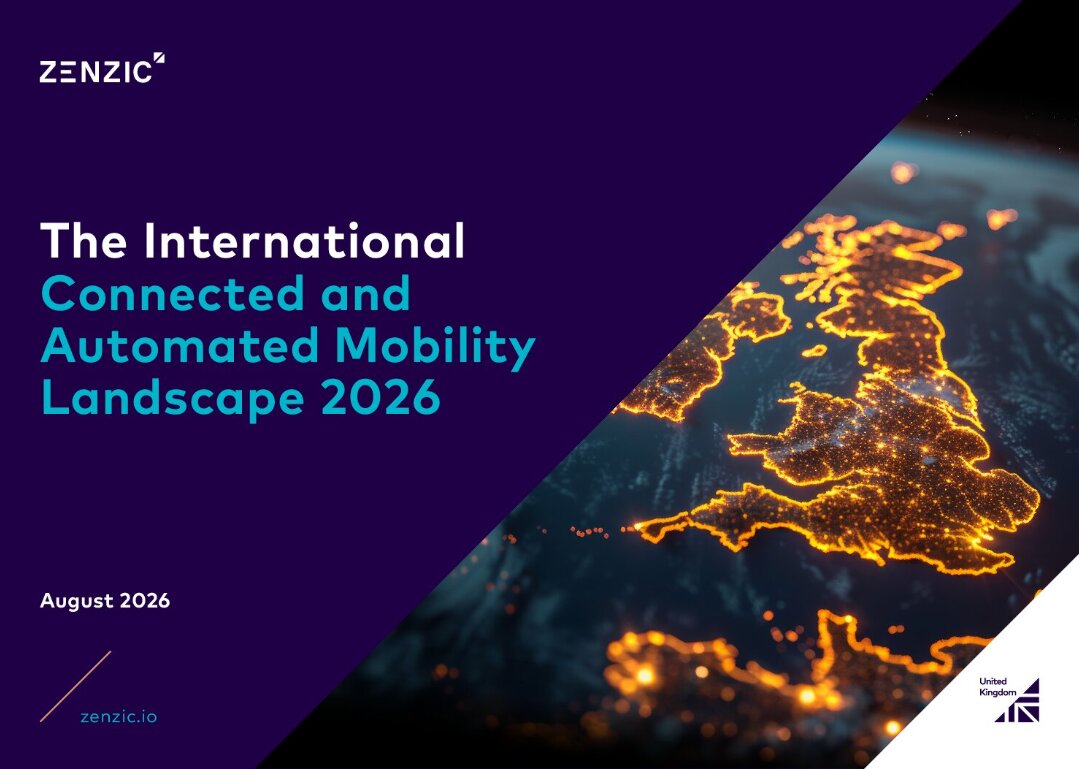
Zenzic’s latest international benchmarking of 11 markets reveals a sector maturing fast and a defined opportunity for the UK supply chain.
For years, the story of connected and automated mobility (CAM) has been one of pilots, sandboxes and proof-of-concept trials across the world. In the midst of a sector in transition, the updated International CAM Landscape report provides readers with a view of the most active global players and the relative competitive positioning for the UK.
Across the eleven markets examined, the sector is moving decisively from experimentation towards permanent commercial deployment. International investment is accelerating, and it is increasingly targeted towards near-market, high-yield applications. For UK companies, understanding where these shifts are heading is the difference between following the market and shaping it.
The report at a glance
The International CAM Landscape 2026 benchmarks eleven markets. Eight markets covered in 2023, building on existing data: the UK, France, Germany, Israel, the USA, Canada, China, and Japan. Three markets have been added this year, South Korea, the United Arab Emirates (UAE) and the Kingdom of Saudi Arabia.
The markets are assessed across three capability areas: policy and regulation, the innovation environment, and testing and deployment. The markets were selected for their economic strength, the visibility of their CAM activity, and their strategic relevance to the UK. The findings draw on desk research and anonymised interviews with public and private sector organisations worldwide.
- From sandboxes to statute
The defining trend of 2026 is the maturation of legal frameworks from temporary trial exemptions to permanent legislation. Germany now issues nationwide Level 4 testing authorisations rather than geographically restricted exemptions. Japan’s 2023 revision of the Road Traffic Act introduced a clear legal pathway for Level 4 operations. France has moved from preliminary safety cases towards a standardised certification framework, and has legislated specifically for autonomous heavy goods vehicles.
Alongside this, the report identifies a global convergence towards liability models that prioritise rapid compensation of victims through the strict liability of the vehicle operator or keeper — allocating risk by statute rather than by litigation. That legal certainty is what unlocks mass-market investment.
The report finds the UK exceptionally well positioned in this shift, with the Automated Vehicles Act 2024 providing one of the most developed statutory authorisation regimes among the markets studied.
- The pivot to industrial and logistics lead markets
Perhaps the most consequential finding is where the money and the maturity now sit. The deployment race has moved away from universal passenger transport, and towards specialised, sector-specific autonomous stacks in high value environments. The report identifies port, airside and factory logistics as the use cases maturing fastest.
The examples are concrete. Westwell’s cabinless Q-Truck has reached commercial maturity in high-intensity port terminals. In Germany, BMW’s iFactory operates large fleets of autonomous mobile robots supported by digital twin infrastructure and private 5G. In aviation logistics, Dubai’s dnata has deployed automated baggage tractors at Dubai World Central Airport following civil aviation approval.
The lesson for investors and developers: the most robust returns and the fastest technical maturity are being proven in ports, airports and factories — not in complex urban traffic.
- Simulation becomes a regulatory requirement
Simulation and digital twins have shifted from a research-and-development convenience to a formal requirement for statutory vehicle approval. Israel uses the Cognata platform to validate edge cases as a condition of approval. Japan now allows high-fidelity simulation data to replace a significant portion of the physical mileage traditionally required for type approval. Germany’s VVM project has established a standardised framework now being proposed as a global ISO standard.
This matters because it acknowledges the statistical impossibility of proving safety through physical driving alone and it lowers the barrier to entry for smaller software innovators who can validate against the same virtual benchmarks as major manufacturers.
- Digital sovereignty and connectivity as the new gatekeepers
Cybersecurity and data governance are no longer technical footnotes; they have become gating requirements for deployment. South Korea requires cybersecurity management system certification before in-service verification. China’s 2025 data security rules impose strict controls on cross-border data transfers. Saudi Arabia requires in-country data hosting. In parallel, 5G and vehicle-to-everything (V2X) connectivity increasingly function as a foundational safety layer rather than an optional enhancement.
For any company targeting global markets, products now have to be designed for sovereign deployment from the outset.
- What this means for the UK
Taken together, the report points to a clear and defensible role for the UK in the global CAM value chain.
Rather than competing on mass hardware manufacturing, the UK’s strengths sit in intellectual property, software, simulation toolchains and especially Verification, Validation and Assurance (VVA). The report frames this as an assurance-as-an-export strategy: building on the Automated Vehicles Act 2024 and established VVA capabilities to export high-integrity software and safety-case frameworks to rapid-growth markets such as the Gulf states and East Asia.
That same industrial pivot shapes the UK’s own deployment strategy. The UK has a concentration of success stories in high-yield, bounded use cases port, airside and factory logistics. The Port of Felixstowe now runs a fleet of 68 autonomous Q-Trucks, and the Aurrigo-led Ramp Ready project at East Midlands Airport is developing autonomous cargo dollies and baggage-handling vehicles. In parallel, global developers are preparing to launch commercial robotaxi services in London under the Automated Passenger Services scheme, pairing near-term economic productivity with scalable passenger transport.
The report’s closing message is a practical one: as the sector fragments into sovereign technology stacks, the UK’s route to advantage lies in forging targeted international collaborations and positioning itself as a low-friction, high-trust gateway for global developers.
Read the full report
The International Connected and Automated Mobility Landscape 2026 contains detailed country-by-country dashboards for all eleven markets, covering policy, funding, and live deployments, and a full assessment of the UK’s position.
Read the report at zenzic.io/knowledge-base
Share