

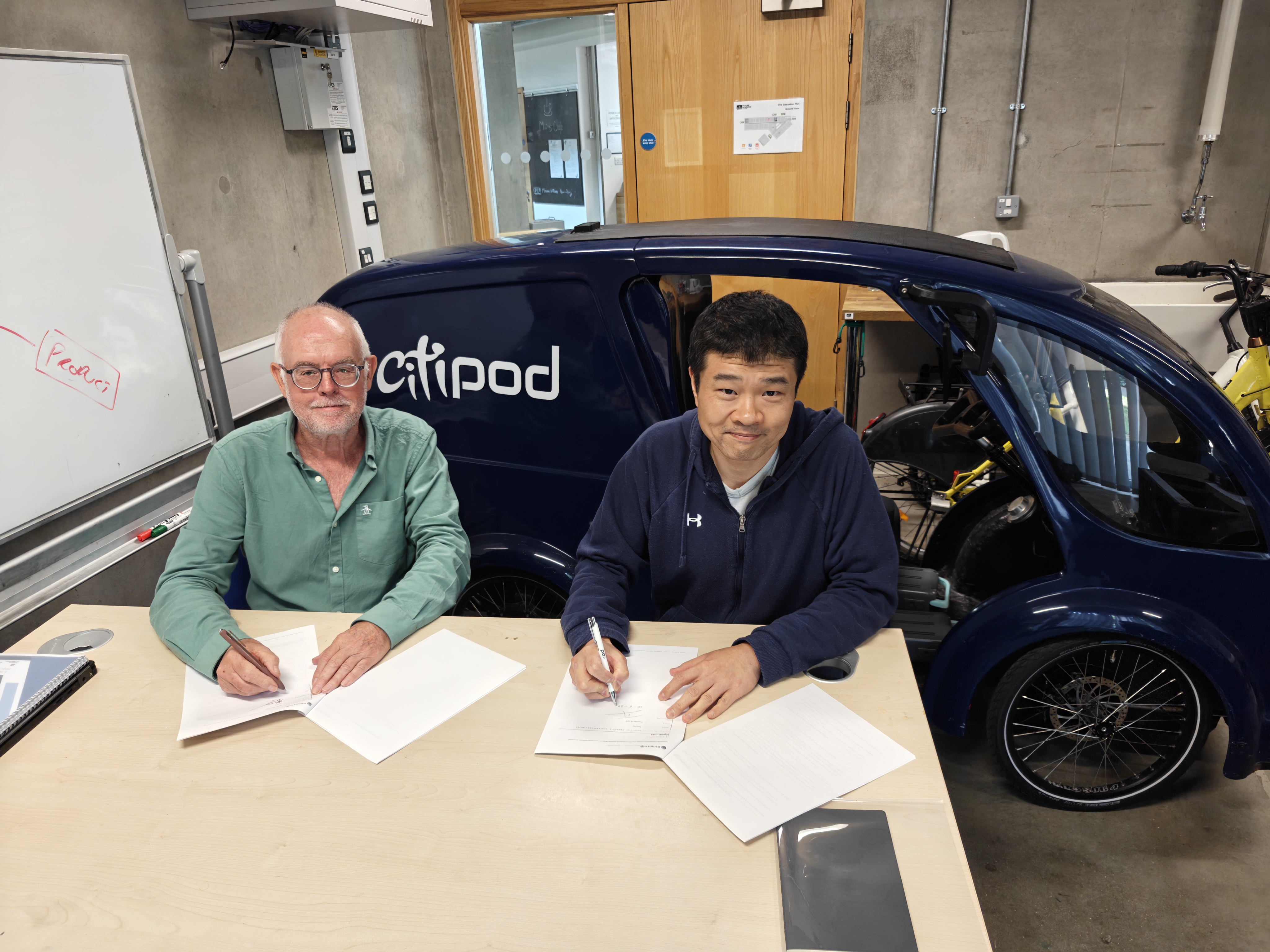
Cambridge Electric Transport (CET) and Osmosis AI have signed a Memorandum of Understanding (MoU) to collaborate on trials of autonomous technology using the CitiPod, a lightweight electric micromobility vehicle developed by CET’s sister company, Micromobility Innovation Ltd.
The collaboration aims to demonstrate how autonomous technology can be deployed safely, rapidly and cost-effectively on lightweight vehicles, providing a practical pathway towards the commercialisation of autonomous transport services in the UK.
The project builds upon the findings of a recently completed UK Government-funded feasibility study by Micromobility Innovation that explored the application of autonomy to lightweight vehicles. The study concluded that micromobility vehicles offer excellent financial return while presenting a significantly lower-cost and lower-risk environment for developing and deploying autonomous technologies than conventional passenger cars and vans.
Under the agreement, Osmosis AI will work with Cambridge Electric Transport and Micromobility Innovation to integrate and test its autonomous software and systems on the CitiPod platform. The trials will investigate a range of use cases, including autonomous repositioning of shared vehicles, first- and last-mile transport services, freight and logistics operations, and campus-based mobility applications.
The partners believe that lightweight autonomous vehicles offer a compelling opportunity for the UK to establish international leadership in an emerging sector while delivering tangible public benefits sooner and at lower cost than many current autonomous vehicle programmes.
Sean Moroney, Founder of Cambridge Electric Transport and Micromobility Innovation, said: “Much of the investment in autonomy has focused on replicating existing cars and transport systems. Our view is that the greatest opportunity lies in applying autonomy to lightweight vehicles, where the technology can be deployed more safely, more affordably and with much greater flexibility.”
“The CitiPod provides an ideal platform for demonstrating this approach. By combining lightweight vehicle design with advanced autonomous capability, we can create practical transport solutions that reduce congestion, lower emissions, improve accessibility and offer outstanding value for money. We believe the UK should be investing far more heavily in lightweight autonomy, where commercial deployment and societal benefits can be achieved in years rather than decades.”
Tony Ho, CEO of Osmosis AI, said: “We are delighted to be working with Cambridge Electric Transport and Micromobility Innovation on this programme. CitiPod is exactly the kind of lightweight, practical vehicle platform where autonomy can be tested and deployed faster, more safely and more affordably than traditional car-scale autonomous vehicle programmes.
Osmosis AI is building DriverAgent — a robotic driver platform that combines vision-based perception, Vision-Language-Action driving intelligence, deterministic safety control and physical actuation. Our focus is not simply to add software to vehicles, but to create a robotic driving layer that can understand its operating environment, reason about the task, and physically control supported vehicles through steering, pedals, gear and braking systems.
This collaboration gives us a strong platform to demonstrate how robotic driver technology can support lightweight autonomous mobility in controlled environments first, before progressing towards wider commercial applications. The aim is practical autonomy: lower cost, faster validation and real-world use cases that can benefit campuses, business parks, mobility hubs, freight operations and first- and last-mile transport.”
The collaboration will initially focus on controlled trials and technical validation, with the longer-term objective of supporting commercial pilot deployments across a range of environments including business parks, science and innovation campuses, healthcare campuses, town centres and transport hubs.
The partners also hope the programme will help inform future UK policy and investment priorities by demonstrating that lightweight autonomous vehicles can provide a scalable, affordable and environmentally sustainable route to autonomous mobility.
As the UK seeks to maintain its position as a global leader in transport innovation, Cambridge Electric Transport and Osmosis AI believe that lightweight autonomy represents an opportunity to achieve faster deployment, stronger economic returns and wider societal benefits than can be delivered through traditional autonomous vehicle programmes alone.
About Cambridge Electric Transport
Cambridge Electric Transport develops and operates innovative shared micromobility, mobility hub and sustainable transport solutions. Through its sister company, Micromobility Innovation Ltd, it is developing the CitiPod, a four-wheel lightweight electric vehicle designed for passenger, cargo and shared mobility applications. (www.citipod.uk)
About Osmosis AI
Osmosis AI develops DriverAgent, a robotic driver system for supported vehicle platforms. The company combines computer vision, Vision-Language-Action driving models, deterministic safety control and robotic actuation to enable vehicles to operate within approved, safety-gated operating domains. Its approach is focused on practical, progressive autonomy: starting in controlled low-speed environments, building safety evidence, and expanding domain by domain. Osmosis AI is based in London and is developing autonomous mobility technology for logistics, micromobility, campus transport and controlled fleet operations. (www.osmosisai.uk)
Share