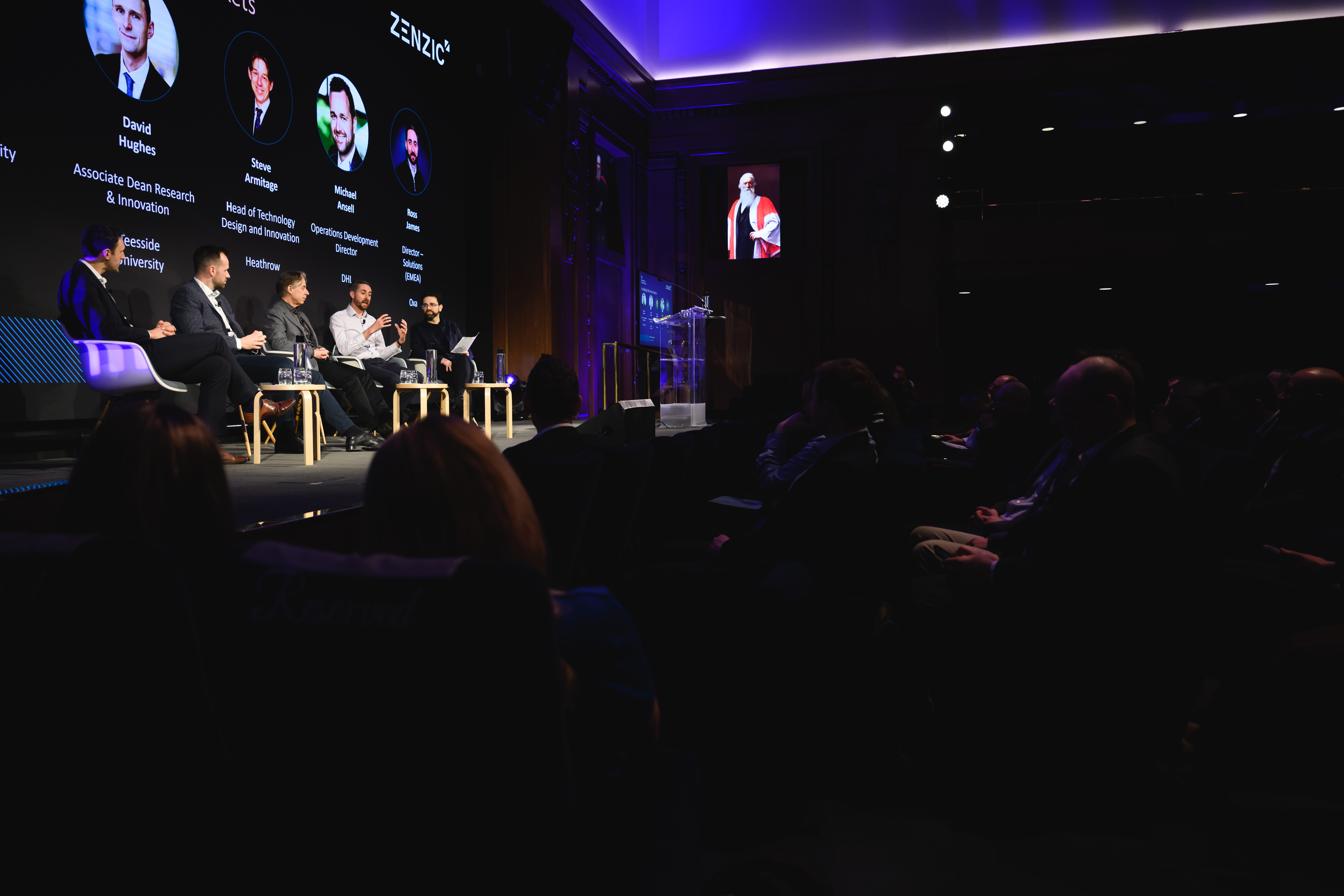


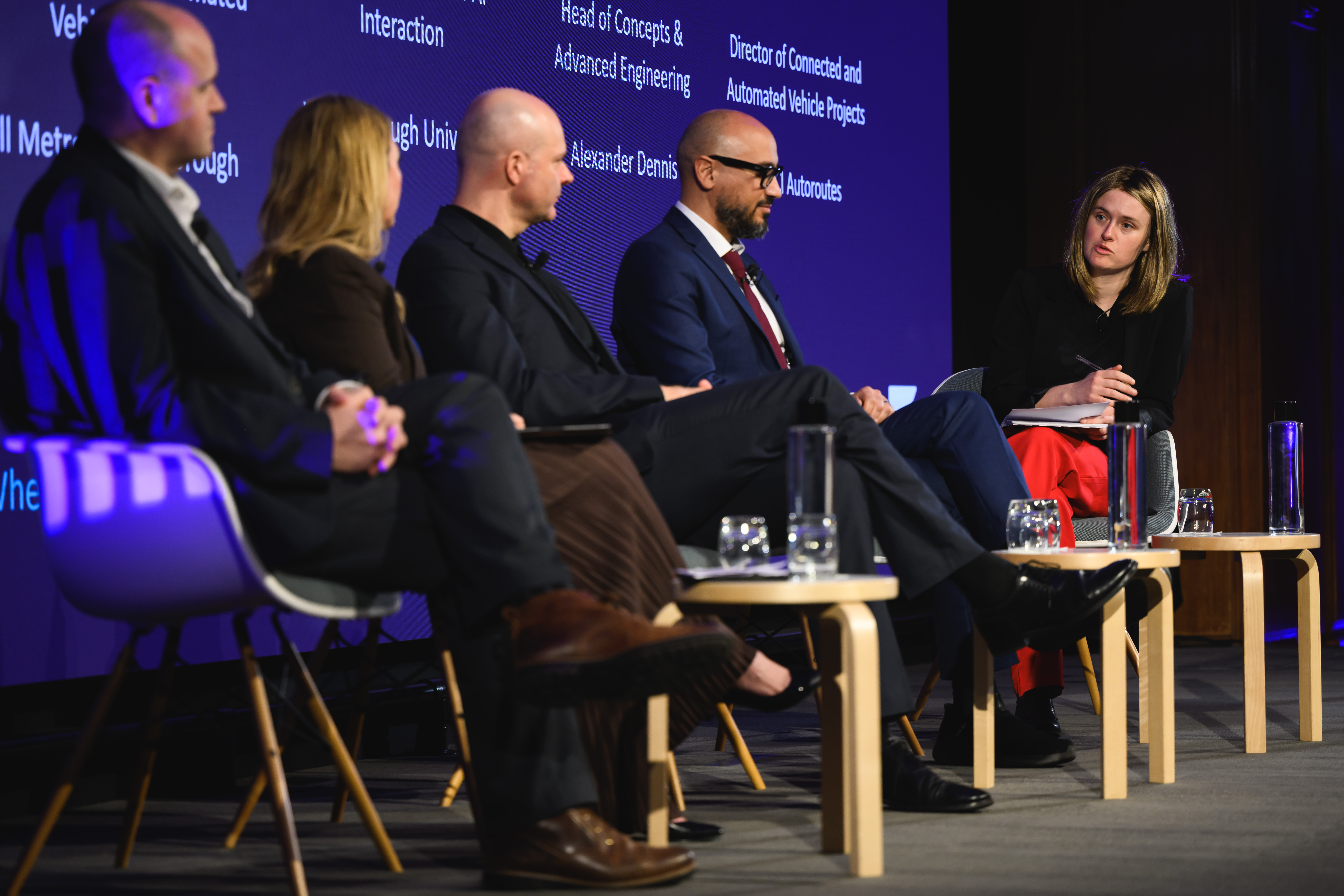
At CAM Innovators’ Day 2026, the discussion on serving the public aligned closely with a broader shift seen across CAM activity: moving from isolated deployments toward integrated services.
The panel provided perspectives from both domestic CAM Pathfinder funded projects and international work. Featuring Pierre Delaigue and Moroine Laoufi of VINCI and VINCI Autoroutes, Jamie Wilson of Alexander Dennis, James Connolly of Solihull Metropolitan Council and Professor Clare Mutzenich of Loughborough University, the panel was chaired by Rebecca Posner of Research Institute for Disabled Consumers (RiDC), grounding the discussion, starting from a system level perspective, in user and accessibility considerations.
The panel reflected experience from, where automated systems are no longer being tested in abstraction, but introduced into live transport environments. This reflects focus less on proving individual technologies and more on how those technologies operate within existing systems; alongside established services, infrastructure and operational models.
“Mobility is a system… the user in the middle… the vehicles… but also the infrastructure.”
— Pierre Delaigue
This system perspective was consistently reflected across the panel. Contributions from Moroine Laoufi, James Connolly and Jamie Wilson all pointed to the same conclusion: performance is determined by how well different elements; vehicle, infrastructure, operations and oversight function together in practice.
Integrating with existing services
Examples discussed throughout the session reinforced that integration is taking place within existing transport networks, rather than through standalone services.
Moroine Laoufi described a deployment on the French motorway network, where automated shuttles are used to complement an existing express coach line – addressing capacity constraints during peak periods and increasing service frequency at quieter times. This reflects a targeted intervention within an established system, rather than the introduction of a new mode.
“We defined the service… understood the need… and tried to size it properly.”
— Moroine Laoufi
A similar approach is evident in UK projects such as Connector 2 and SCALE 2, referenced during the panel. These projects focus on integrating automated services into public transport networks, including first and last mile connectivity and demand-responsive operation, rather than operating independently.
Across these examples, automation is positioned as a means of adjusting service performance – improving frequency, flexibility or coverage within the constraints of existing transport networks.
Operational considerations
As deployments move into live environments, operational considerations become more prominent. The panel highlighted that introducing automated services requires changes not only to vehicles and infrastructure, but also to how services are managed and delivered.
Moroine Laoufi noted the emergence of new roles, such as remote supervisors, who take on responsibilities previously held by drivers, alongside additional coordination tasks.
“You used to have a driver… now you have a remote supervisor… this is a new job.”
— Moroine Laoufi
From an OEM perspective, Jamie Wilson emphasised that system assurance extends across all aspects of operation, not just the vehicle itself.
“The safe system isn’t just the tech… it’s everything that supports that.”
— Jamie Wilson
This reflects the need to align vehicle capability with operational processes, maintenance regimes and supporting infrastructure, ensuring that services can be delivered consistently and safely.
Constraints to deployment
The panel also identified a number of constraints that affect the pace and scale of deployment. These were primarily non-technical.
Laoufi highlighted the time required to move from concept to on-road deployment, noting that project timelines are often driven by approval and authorisation processes rather than technology readiness.
“It took two years… not because the technology was not ready…”
— Moroine Laoufi
Connolly referenced the challenge of defining and delivering services that meet specific local needs, particularly where multiple use cases are considered simultaneously.
“How we… bottom out what are the use cases… and what are the communities that we’re trying to support…”
— James Connolly
These factors point to the importance of clearly defined applications and aligned processes when moving toward scaled deployment.
Interaction in live environments
User interaction was discussed in the context of live service operation. Drawing on human factors research, Professor Mutzenich highlighted how behaviour can vary in unfamiliar or unexpected situations.
“People are not predictable… especially when we panic.”
— Clare Mutzenich
Projects such as Connector 2 have already explored these interactions through both simulated and real-world environments, examining how users board, engage with and respond to automated services.
The discussion also referenced the wider experience of using public transport, including the need for planning and adaptation throughout a journey. Reducing this complexity – through more predictable and responsive services – was identified as an area where automation may contribute to improved service experience.
Toward integrated deployment
The session reflected a consistent shift toward operational integration. Automated systems are being introduced into defined parts of the transport network, where they can contribute to service performance and be evaluated in real conditions.
“Technology for mobility needs… not technology for the sake of technology.”
— Pierre Delaigue
Across both CAM Pathfinder projects and international examples, the conversations provided focus on how the vehicles within services function as part of a wider system, with integration into existing networks acting as a key step toward wider adoption.
Share