

Zenzic

Enhancements

Connector 2 Case Study

This project builds on the Connector project, originally funded through the Commercialising CAM: Deployment competition. Connector 2 seeks to extend the Connector trials at Cambridge West and Biomedical Campus, together with work to explore how this technology can support deployments on both the future and existing Cambridgeshire Busways.

Project Overview

Connector 2 builds on the scope of Connector, a project which was also funded by the UK Government. Connector 2 is designed to test whether autonomous services can improve connectivity, particularly on routes that are currently difficult to serve commercially.

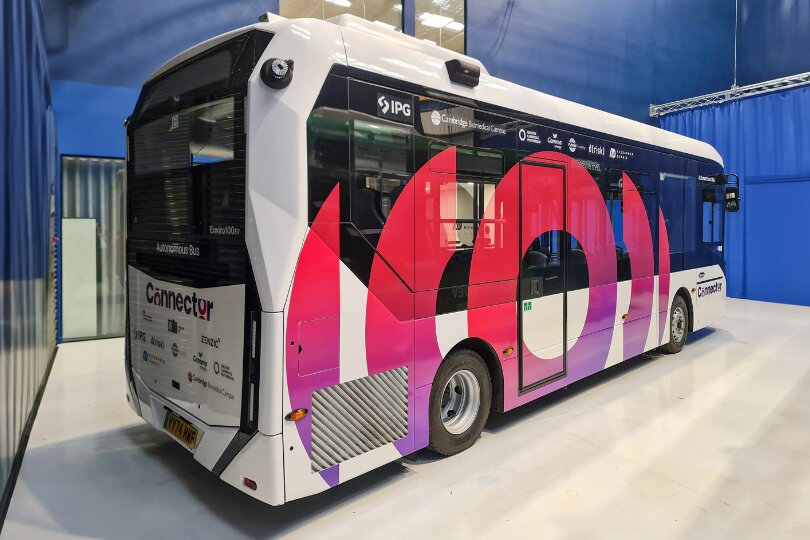
The Connector 2 project has deployed autonomous buses in Cambridge to explore how connected and automated mobility (CAM) can support the future of public transport. Connector 2 uses Alexander Dennis buses, which are fitted with Fusion Processing’s CAVStar technology to provide the autonomous drive capability.

The system is capable of operating at full autonomous (SAE Level 4). During the trial, however, a trained safety driver has remained on board at all times to supervise the system and intervene if required, in line with current legislation.

Two buses operate between the Trumpington and Babraham Park & Ride sites via the Cambridge Biomedical Campus and Addenbrooke’s Hospital. A third bus runs between Madingley Road Park & Ride and Eddington, connecting key employment, research, and residential areas.

The Connector 2 project builds on previous UK Government supported activity. Across the projects covered, the buses have travelled over 4,000 autonomous kilometers and carried almost 2,500 passengers.

The project is funded by the UK Government through the CAM Pathfinder Programme, delivered by the Department for Business and Trade in partnership with Innovate UK and Zenzic.

Connector 2 successes have generated substantial interest both in the UK and internationally, galvanising the autonomous public transport supply chain and positioning the UK, and particularly, Cambridge as a world leader in the sector.

Context and opportunity

Across the UK, bus operators and local authorities face increasing challenges in maintaining economically viable services particularly in rural areas and during off-peak hours. At the same time, driver recruitment, training and rising operating costs are placing additional pressure on the network.

Greater Cambridge Partnership are delivering a plan to try and reduce traffic by 20-25% from a 2019 baseline, while also doubling the size of the bus network and tripling the number of passengers.

Autonomous buses could be part of the solution by reducing operating costs, improving safety, and enabling more flexible service models. This could unlock new routes, improve access to employment and services, and support wider economic and environmental policy outcomes.


The Greater Cambridge Partnership (GCP) is using Connector 2 to build the evidence required to assess whether autonomous buses can form part of a future integrated transport system. This includes technical performance, safety validation, passenger acceptance, and commercial viability.

Crucially, the project provides real-world insights that cannot be generated through simulation alone helping to de-risk future investment and inform national policy development.

The Connector 2 project primarily uses Alexander Dennis buses as the platform for the automated driving technology. The project team have used three Enviro100AEVs and one Enviro200AV. One Mellor OrionE has also been deployed as part of the project.

Connector 2 uses the CAVstar automated drive system. The CAVstar system consists of Fusion Processing’s AI processing unit running on proprietary algorithms and software coupled with radar, LIDAR and optical cameras, which enable the system to analyse and understand its environment; to anticipate movements of other vehicles and vulnerable road users; then plan and execute a safe path to its destination.

.

Challenges

Technical

Operating autonomous buses in a complex urban environment presents significant challenges.

The system is designed to strictly comply with the Highway Code, which can result in behaviour that differs from human driving norms. For example, the buses will not overtake cyclists unless 1.5m clearance can be maintained. While this improves safety, it can lead to congestion, frustration in other road users and requires careful consideration of how autonomous vehicles integrate with human road users.

Infrastructure constraints also present challenges. On one route, a narrow S-bend requires buses to either encroach into the opposite lane or overhang the pavement. Human drivers typically negotiate this through informal communication such as eye contact and hand signals. Replicating this type of interaction remains a key challenge for autonomous systems.

Commercial

Another key project objective is to understand and quantify the commercial viability of an autonomous bus service. Understanding people’s willingness to ride on a self-driving bus is important in this.

As part of the rules of the Connector 2 trial the bus operator does not charge passengers to ride. Therefore a key constraint has been identifying trial routes that deliver passenger value without competing with existing commercially operated services.

Assessing uptake through passenger numbers, combined with surveys of passengers’ willingness to pay for such a service will provide meaningful evidence, and a signal of commercial viability.

Social

Public acceptance and trust remains critical to developing a commercial model. This will be contingent on providing an inclusive and accessible service that passengers feel safe using.

Human factors work has been conducted to produce evidence to design an autonomous service and delivery which supports existing users and encourages current non-users to adopt new transport technology.  

Objectives

Connector 2 has been designed to address key questions for government, operators, and technology providers:

  • How autonomous buses can integrate into existing public transport networks
  • Whether autonomy can enable viable services on underserved routes
  • What regulatory and legislative changes may be required
  • How passengers perceive and respond to autonomous travel
  • What safety considerations arise, including for vulnerable users and those travelling alone
  • To what extent AV services can be inclusive across all protected characteristics
  • The total cost of ownership, operation, and long-term commercial viability

For technology partners, the project also aims to accelerate the development of a viable autonomous bus platform that can be used commercially. Following significant government investment in the industry these trials will position the UK-based supply chain as a leader in automated public transport.

Key Outcomes

Connector 2 has demonstrated that autonomous buses can operate in a live urban environment, interacting safely with other vehicles, cyclists, and pedestrians under real-world conditions.

Key findings include:

  • Operational performance: The vehicles successfully completed regular service patterns across complex routes, including high-traffic and constrained environments
  • Safety: The system consistently prioritised compliance with road rules and cautious interaction with vulnerable road users
  • Passenger response: Survey data indicates that passengers are broadly positive about the experience, with confidence increasing after use
  • Technical learning: The trial has highlighted specific edge cases – such as informal driver interactions and constrained road layouts – that require further attention

While a safety driver was required throughout, the trial provides a clear pathway towards reducing on-board supervision as technology and regulation evolve.

Impact and future potential

Connector has the potential to enable longer-term data collection and further system development. This positions Cambridge as a leading UK authority for on-road autonomous public transport.

The project has:

  • De-risked early-stage deployment, generating evidence that supports future public and private investment
  • Informed national policy development, particularly in areas such as safety assurance, operational design domains, and regulatory frameworks
  • Supported local authority capability, with insights shared through a national network of councils exploring CAM solutions

Looking ahead, the Greater Cambridge Partnership intends to use the findings to inform the potential commissioning of a commercial autonomous bus service. It is hoped autonomy could provide solutions to complex public transport challenges that don’t currently have commercially viable options under existing operating models. An example is how to connect disparate campuses to travel hubs like the train station.

However, several challenges remain before large-scale deployment, including:

  • Achieving a commercially viable cost base
  • Establishing clear regulatory frameworks, including the role of safety drivers and remote supervision
  • Ensuring public trust and widespread acceptance

If these challenges can be addressed, autonomous buses could play a significant role in expanding public transport provision, supporting economic growth, and strengthening the UK’s position in a globally competitive sector.

Partners

Connector 2 brings together a consortium of public and private sector partners:

  • Greater Cambridge Partnership (GCP): Lead partner responsible for overall delivery
  • Whippet: Bus operator responsible for day-to-day service operation and safety drivers
  • Alexander Dennis: Manufacturer of the Enviro100AEV electric buses
  • Fusion Processing: Provider of the CAVstar® automated driving system (SAE Level 4 capability)
  • dRISK: Supplier of a large database of edge-case driving scenarios
  • IPG: Developer of a digital twin environment for virtual testing and validation
  • Anthrometric: Specialist in accessibility and inclusion research for automated transport

Why this matters for the UK

Connector 2 demonstrates how government-funded innovation can accelerate the development of emerging transport technologies while delivering tangible public value.

By enabling real-world testing, the CAM Pathfinder programme is helping to:

  • Build UK leadership in connected and automated mobility
  • Generate evidence for the viability of autonomous public transport solutions in the UK
  • Support emerging commercial pathways for CAM technologies in the automotive industry

As the UK moves towards commercial deployment of autonomous mobility, projects like Connector 2 provide the critical evidence base needed to move CAM technologies from trial to commercialisation.

{{ teamMember.name }}

{{ teamMember.title }}

Close
Close
Zenzic

Join our newsletter to be the first to hear about funding opportunities, emerging projects and new sector intelligence

By signing up to our newsletter you will receive regular emails from Zenzic. You can unsubscribe at any time by clicking the link in the footer of our emails. For information about our privacy practices, please read our privacy policy.

Close
Zenzic

Download the UK Connected and Automated Mobility Roadmap: CAM Creators Update now

View the online interactive UK Connected and Automated Mobility Roadmap: CAM Creators Update now

If you would like to receive our regular newsletter please tick the box

By signing up to our newsletter you agree to our privacy policy.

Close
Zenzic

Download The Safety Case Framework: The Guidance Edition for creators now

Download The Safety Case Framework: Non-technical explainer now

Download The Safety Case Framework: Useful templates now

Download The Safety Case Framework: Workshop Slides now

Download The Embedding Safety Case: Next Steps for Trialling report now

Download The Consumer Safety Rating Scheme: now

Download The Safety Case Framework: The Guidance Edition for reviewers now

If you would like to receive our regular newsletter please tick the box

By signing up to our newsletter you agree to our privacy policy.

Close
Zenzic

If you would like to receive our regular newsletter please tick the box

By signing up to our newsletter you agree to our privacy policy.

Close
Zenzic

If you would like to receive our regular newsletter please tick the box

Click here if you are happy for your details to be shared with our delivery partner Plug & Play

Click here to confirm that your company is registered in the UK

By signing up to our newsletter you agree to our privacy policy.

Close
Zenzic

Download The Interoperable Simulation Report now

If you would like to receive our regular newsletter please tick the box

By signing up to our newsletter you agree to our privacy policy.

Close
Close
Close
Zenzic

Download the Cyber Resilience in CAM - Cyber Feasibility Report now

If you would like to receive our regular newsletter please tick the box

By signing up to our newsletter you agree to our privacy policy.

Close
Zenzic

Download the CAM Scale-Up Information Pack now

Click here if you are a UK-based company or looking to create a base here

Are you an SME/start-up?

Click here if you are happy to share your details to be shared with our delivery partner Plug & Play

If you would like to receive our regular newsletter please tick the box

By signing up to our newsletter you agree to our privacy policy.

Close
Zenzic

Download the CAM Scale-Up SME Brochure now

If you would like to receive our regular newsletter please tick the box

By signing up to our newsletter you agree to our privacy policy.

Close
Zenzic

Download the Simulation to 2030 Report now

If you would like to receive our regular newsletter please tick the box

By signing up to our newsletter you agree to our privacy policy.

Close
Zenzic

Download the Simulation to 2030 Report now

If you would like to receive our regular newsletter please tick the box

By signing up to our newsletter you agree to our privacy policy.

Close
Zenzic

Download the Simulation to 2030 Report now

If you would like to receive our regular newsletter please tick the box

By signing up to our newsletter you agree to our privacy policy.